Rose Hill Resident Launches Urban Farm Business To Cultivate Honey and Wildlife Connections
Firstly, thanks to our community for supporting Aster Waves, the micro farm business I founded in 2025. I am honored to be sharing our story in The Rambler.
The seeds for Aster Waves were planted during the 1990s when my teenage self-maintained an extensive garden and worked on horse farms. My interests in horticulture and animal husbandry have persisted, although they were sometimes muted by life circumstances.
However, over the last decade, my farming dreams experienced several accelerants:
1) The purchase of my home in Rose Hill (with land…and dirt!) after years of apartment living.
2) The development of my interest in wildlife conservation, especially pollinators, resulting in my property becoming a certified wildlife sanctuary.
3) As an extension of this interest, becoming a beekeeper and the correlated bee husbandry mentoring I’ve received; and
4) Due to my husband’s veteran status, our participation in Arcadia Farms Veteran Farmer Reserve training program during 2025.
Of these, the Arcadia program was especially impactful for formalizing my interests in wildlife conservation and sustainable agriculture into a fledgling but more formal farm business.
As an enterprise, Aster Waves’ mission is to strengthen our community through accessible and sustainable agriculture. We hope to humanize a connection to farming and drive better harmony with each other and with wildlife. The support and engagement we have received from our neighbors thus far gives me hope that we are on the right path.
Interestingly, the very nature of beekeeping drives connection. Bees demand a high skill level. I benefited from working with mentors, and now that my skill level has matured, I am mentoring new beekeepers and running for an officer position with the Northern Virginia Beekeepers Association.
For the near term, we seek to drive a big impact despite our ¼ acre suburban lot. Bees provide a unique opportunity when land is limited as their space requirements are far less than most other livestock. Additionally, many beekeepers have multiple apiaries at no additional cost due to the desirability of bees’ presence for pollination. Honey, as a crop, is conducive to small-scale farming because of its shelf life; it lasts thousands of years in optimal conditions which helps avoid perishability losses. Honey is also a highly desired product; it has terroir, similar to wine, which means the taste is highly dependent on its growing environment. Our honey naturally changes throughout the year and from year to year but always reflects the terroir of Rose Hill.
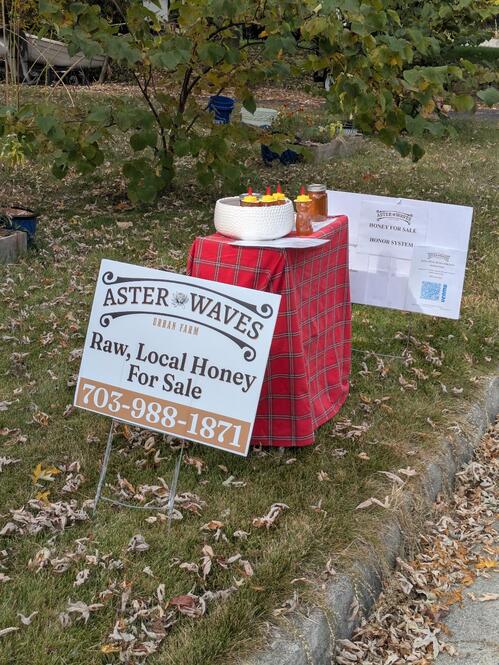
Bees are industrious creatures; with only a few hives, our 2025 honey crop neared 25 gallons, which is higher than average and likely the result of my other gardening activities. Thanks to the support of our community, most of this inventory is sold and I expect the business to be profitable in 2026.
Honey is indeed a sweet part of our story, although we are writing more chapters. Our current product list goes beyond honey to include beeswax, loofah and birdhouse gourds, and during 2026, we plan to further experiment with flowers, attend more markets and continue to explore purchasing additional land.
If you are interested in following our journey, you can find us at asterwaves.com, on Instagram (@aster_waves_urban_farm), on Nextdoor (Aster Waves Urban Farm) and at our home at 4404 Roundhill Road.
Lydia Lawless is the founder of Aster Waves Urban Farm
The seeds for Aster Waves were planted during the 1990s when my teenage self-maintained an extensive garden and worked on horse farms. My interests in horticulture and animal husbandry have persisted, although they were sometimes muted by life circumstances.
However, over the last decade, my farming dreams experienced several accelerants:
1) The purchase of my home in Rose Hill (with land…and dirt!) after years of apartment living.
2) The development of my interest in wildlife conservation, especially pollinators, resulting in my property becoming a certified wildlife sanctuary.
3) As an extension of this interest, becoming a beekeeper and the correlated bee husbandry mentoring I’ve received; and
4) Due to my husband’s veteran status, our participation in Arcadia Farms Veteran Farmer Reserve training program during 2025.
Of these, the Arcadia program was especially impactful for formalizing my interests in wildlife conservation and sustainable agriculture into a fledgling but more formal farm business.
As an enterprise, Aster Waves’ mission is to strengthen our community through accessible and sustainable agriculture. We hope to humanize a connection to farming and drive better harmony with each other and with wildlife. The support and engagement we have received from our neighbors thus far gives me hope that we are on the right path.
Interestingly, the very nature of beekeeping drives connection. Bees demand a high skill level. I benefited from working with mentors, and now that my skill level has matured, I am mentoring new beekeepers and running for an officer position with the Northern Virginia Beekeepers Association.
For the near term, we seek to drive a big impact despite our ¼ acre suburban lot. Bees provide a unique opportunity when land is limited as their space requirements are far less than most other livestock. Additionally, many beekeepers have multiple apiaries at no additional cost due to the desirability of bees’ presence for pollination. Honey, as a crop, is conducive to small-scale farming because of its shelf life; it lasts thousands of years in optimal conditions which helps avoid perishability losses. Honey is also a highly desired product; it has terroir, similar to wine, which means the taste is highly dependent on its growing environment. Our honey naturally changes throughout the year and from year to year but always reflects the terroir of Rose Hill.
Bees are industrious creatures; with only a few hives, our 2025 honey crop neared 25 gallons, which is higher than average and likely the result of my other gardening activities. Thanks to the support of our community, most of this inventory is sold and I expect the business to be profitable in 2026.
Honey is indeed a sweet part of our story, although we are writing more chapters. Our current product list goes beyond honey to include beeswax, loofah and birdhouse gourds, and during 2026, we plan to further experiment with flowers, attend more markets and continue to explore purchasing additional land.
If you are interested in following our journey, you can find us at asterwaves.com, on Instagram (@aster_waves_urban_farm), on Nextdoor (Aster Waves Urban Farm) and at our home at 4404 Roundhill Road.
Lydia Lawless is the founder of Aster Waves Urban Farm
Recent
Rose Hill Civic Association Elects New Officers
June 23rd, 2026
How I Turned My Backyard into a Wildlife Sanctuary
May 26th, 2026
Rose Hill Resident Launches Urban Farm Business To Cultivate Honey and Wildlife Connections
February 21st, 2026
Rose Hill Civic Association Meeting on Tuesday, January 27 Cancelled
January 26th, 2026
Steven Able: What It Means To Be a Coach
November 26th, 2025
Archive
2026
2025
2024
May
2023
August
October
November
Categories
no categories